AI and product decisions · DP085
A privacy review for a new product experiment
Make a product experiment review end with a clear launch decision, bounded data collection and a plan for failure.
Research cutoff: . This dated explainer is general information; check the linked instruments and your circumstances before acting.

A small experiment can introduce a large new data flow. Imagine a team changing one screen while adding a tracking service, storing form contents for debugging and sending test audiences to a marketing tool. Reviewing only the visible screen misses the privacy decisions created by the experiment.
Use a focused review that compares the proposed flow with the current one. The outcome should be a concrete launch decision, including conditions and a way to stop the experiment if those conditions are not met.
Write a one-paragraph experiment description
State the question, the people affected, the duration and the intended decision. ‘Test whether a shorter booking form reduces incomplete submissions’ gives the review something specific to examine. ‘Improve engagement’ can conceal several different purposes and an open-ended collection.
List the new fields, events, recipients and copies. Include operational logs and support tools, not only the main product database. Identify whether the experiment changes what the person was told or the choice they made.
As of 22 October 2026, the relevant substantive DPDP duties are scheduled for 13 May 2027 under the commencement notification. The future sections 4 to 8 will shape the processing-route, notice, consent and safeguard assessment. The review method here is practical preparation, with existing applicable requirements assessed separately.
Ask what makes this experiment different
Compare the proposed purpose with the existing one. A change that merely rearranges a form can differ from a change that reuses answers to build a profile. Do not assume that the word ‘experiment’ supplies a legal basis or makes a new use temporary enough to ignore.
Check the audience. A feature accessible to children needs the relevant section 9 assessment. A test that affects a person’s access, price or service outcome deserves careful attention to the information used and the consequences of error. Avoid treating a small sample as proof that the impact is unimportant.
Decide whether synthetic records or a constrained internal exercise can resolve early design questions before real personal data is needed. If real data is necessary, document why and narrow the scope.
A hypothetical booking experiment
A service business wants to shorten its booking form. The product team initially proposes logging every incomplete field to learn where people struggle. The privacy review asks whether the question can be answered with the step reached and a bounded error category instead.
The team tests the narrower event design with synthetic bookings. Reviewers inspect the actual payload and confirm that names, contact details and free-text comments are excluded. They also test a declined optional choice and a failed submission, because error paths can behave differently from the successful path.
The launch decision approves the experiment for a defined period, assigns an owner to the event schema and specifies what happens to working datasets afterwards. If a new field is added, the approval is revisited rather than assumed to cover it.
Distinguish a useful review from a statutory DPIA claim
Any team can adopt an impact-assessment method as good practice. The specific additional duties for a Significant Data Fiduciary arise through the section 10 framework, with rule 13 addressing its periodic assessments and audits. Do not state that every business or every small product test has an identical statutory annual DPIA requirement.
If SDF status or another applicable requirement is relevant, assess it explicitly. Otherwise, describe the review honestly as an internal decision process. A named template does not make the analysis complete; its usefulness depends on the actual questions and evidence.
Test the controls the decision relies on
Verify access, recipient scope, choice handling and the relevant retention behaviour. Where an external service receives data, inspect its role and the applicable arrangement. Record a limitation if the test cannot establish part of the flow.
Give someone authority to pause the experiment. Define the trigger in concrete terms, such as an unexpected payload field or a choice that fails to control an export. A rollback plan should address stored records and downstream copies as well as the visible feature switch.
After the experiment, compare the observed result with the original question. Retain evidence needed for the decision under the applicable rules, and review unnecessary working data. Do not turn a temporary analysis into an unexplained permanent database.
The recurring failure is a review that produces comments but no decision. Record what is approved, what remains unresolved and who owns the next action. That gives product teams a usable boundary for learning without silently expanding the data they collect.
Make the experiment review end in a decision
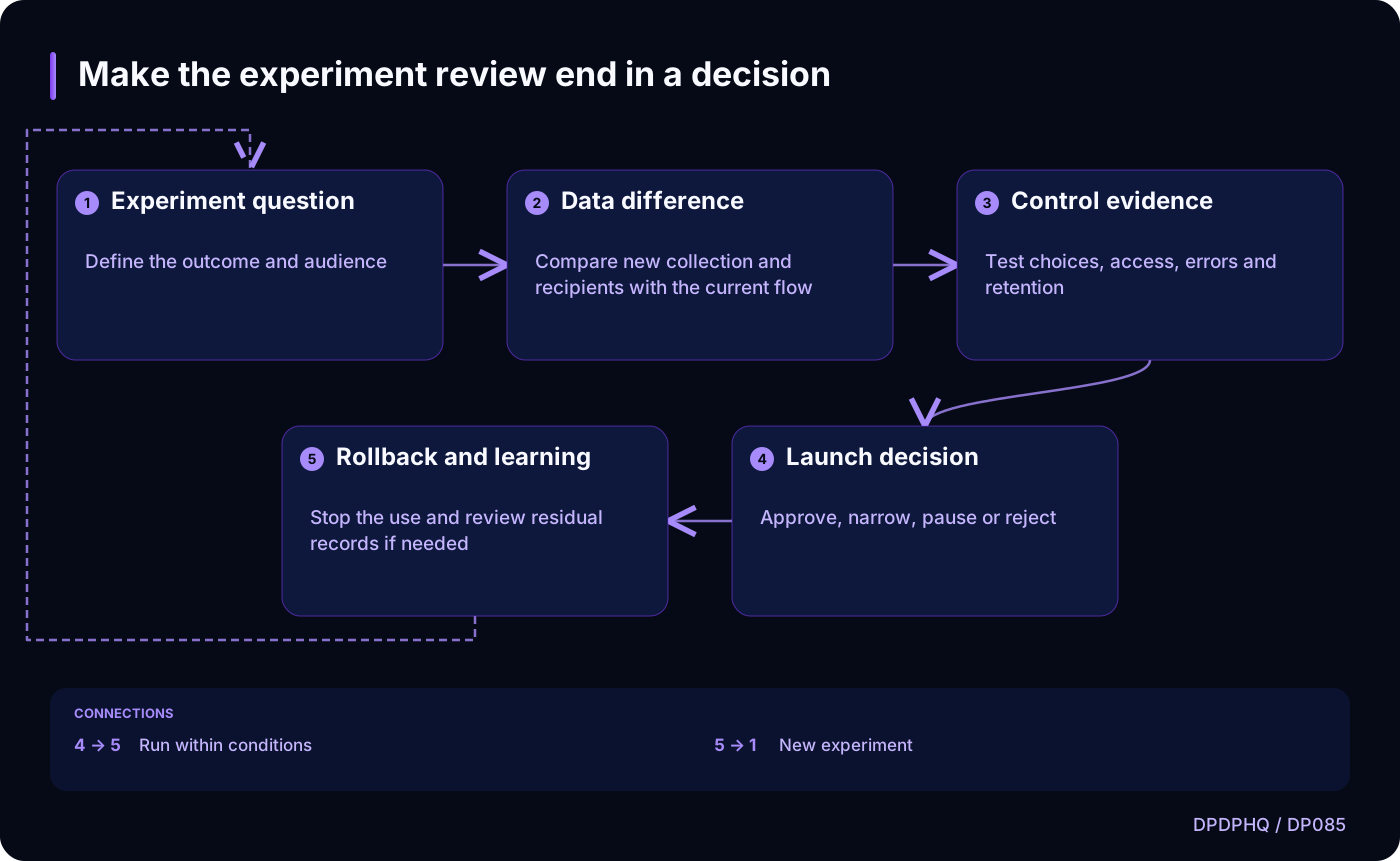
Text version of the diagram
- Experiment question: Define the outcome and audience
- Data difference: Compare new collection and recipients with the current flow
- Control evidence: Test choices, access, errors and retention
- Launch decision: Approve, narrow, pause or reject
- Rollback and learning: Stop the use and review residual records if needed
- Experiment question → Data difference
- Data difference → Control evidence
- Control evidence → Launch decision
- Launch decision → Rollback and learning: Run within conditions
- Rollback and learning → Experiment question: New experiment
Sources and reading context
These references support the original 22 October 2026 research. Source links and the date above make the scope of this article explicit.
- Commencement notification for provisions of the DPDP Act · paragraph (c)
Dates future obligations
- Digital Personal Data Protection Act, 2023 · sections 4 to 8, 9, 10
Grounds, safeguards, children and SDF distinctions
- Digital Personal Data Protection Rules, 2025 · rule 13
SDF-specific assessment duties