Operations and measurement · DP096
Choosing a privacy tool when your processes are still evolving
Choose a privacy tool by the workflow it can demonstrate and the decisions your organisation is ready to operate.
Research cutoff: . This dated explainer is general information; check the linked instruments and your circumstances before acting.

A team with an evolving privacy process can be drawn to a tool that promises to organise everything. The risk is buying a broad system before deciding who owns the work, which decisions it should enforce and what evidence the business needs.
Choose one workflow first. A tool is easier to assess when you can show where information enters, what action is required, who handles an exception and how completion will be verified.
Define the job the tool should perform
Examples include recording a promotional choice, routing a privacy request, tracking provider evidence or carrying out a defined deletion task. Avoid starting with ‘make us compliant’, which combines legal interpretation, governance and many operational activities into an untestable promise.
Write the input, expected result, responsible owner, connected systems and failure conditions. Identify which decisions are yours, such as the lawful purpose or retention requirement, and which actions you expect the tool to perform after those decisions are made.
As of 22 October 2026, the notified DPDP framework has phased commencement. The Consent Manager registration phase is scheduled for 13 November 2026 and most substantive duties for 13 May 2027 under the Act commencement notification and rule 1(3) and 1(4). Assess present product capabilities and readiness for relevant duties without claiming that a purchase itself establishes legal compliance.
Ask for evidence tied to your configuration
Request a demonstration of the service and settings you would actually use. A feature in another plan, deployment or future roadmap does not prove availability in your intended arrangement. Record the date and scope of what was demonstrated.
Under the future section 8(1) and 8(5) framework, accountability and safeguards will remain relevant even when software performs part of the work. Rule 6 covers several safeguard categories; one attractive dashboard or encryption statement does not answer all of them.
Ask how the tool handles permissions, provider access, operational logs, retained copies and an incident. Keep the questions focused on the workflow rather than collecting a stack of unrelated assurances.
A hypothetical withdrawal pilot
A small retailer wants to make promotional withdrawals dependable across a billing system and a campaign service. It defines the event, the recipient systems, the expected stop behaviour and the evidence needed to show that the choice reached both places.
The pilot uses synthetic records. One withdraws normally, one receives a duplicate event and one encounters an unavailable downstream service. The team checks what the tool records, what remains pending and whether an employee can resolve the exception without reintroducing the record into a campaign.
The result may show that the tool supports part of the process well but requires an additional integration or manual step. That is a useful finding. The team can decide whether the remaining work is manageable instead of treating a successful normal-path demo as proof of complete coverage.
Keep statutory titles separate from product descriptions
A registered Consent Manager is a defined legal role under section 6(9) and rule 4 with the First Schedule. Software that stores preferences or routes consent events is not automatically registered in that role. Verify a claimed statutory status through appropriate official evidence rather than inferring it from the product name.
You can still evaluate ordinary workflow software on its demonstrated capabilities. The distinction prevents both overclaiming and unnecessary confusion about what the product is meant to do.
Budget for operation, not only setup
Identify who will configure purposes, maintain integrations, review failures and update the process when the law or business changes. Include training and evidence review in the plan. A tool that needs careful configuration can be useful, but the configuration work cannot be left without an owner.
Check whether the team can understand the result. An unexplained score or status badge may be less useful than a clear record of the action, recipient, time and unresolved exception. The output should support a decision your staff can make.
Preserve a workable exit
Ask what records can be exported, in which form, and whether the export preserves the information needed to understand past decisions. Review account closure, provider-held copies, integration removal and the treatment of legally retained material.
Avoid a pilot that quietly becomes permanent because nobody planned its ending. Set a review date and conditions for adoption, extension or closure.
Define the process before committing to the feature list. A bounded pilot with observable outcomes helps the organisation choose a tool it can operate, identify the remaining responsibilities and improve the workflow without claiming more than the evidence supports.
Evaluate the tool against a bounded workflow
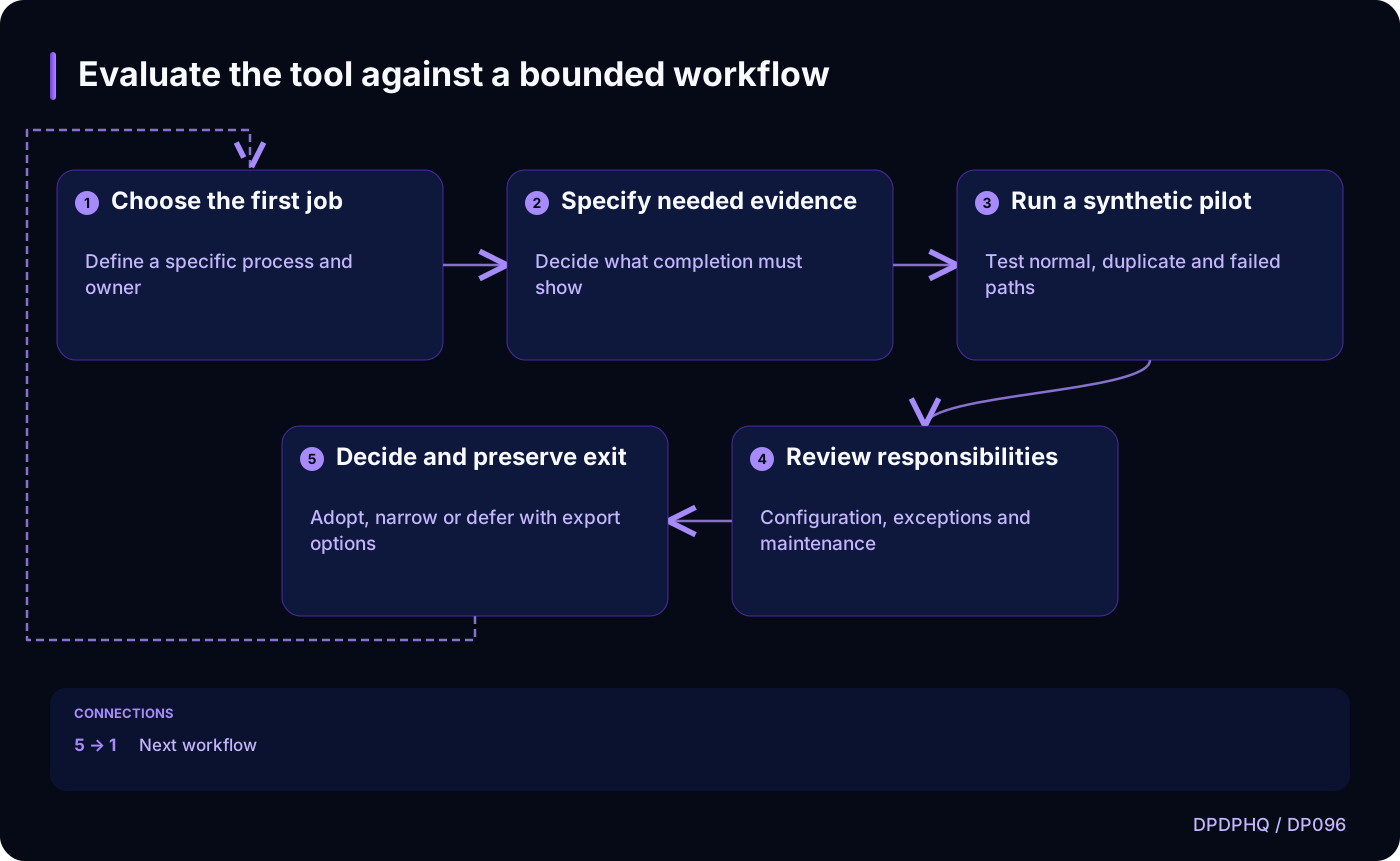
Text version of the diagram
- Choose the first job: Define a specific process and owner
- Specify needed evidence: Decide what completion must show
- Run a synthetic pilot: Test normal, duplicate and failed paths
- Review responsibilities: Configuration, exceptions and maintenance
- Decide and preserve exit: Adopt, narrow or defer with export options
- Choose the first job → Specify needed evidence
- Specify needed evidence → Run a synthetic pilot
- Run a synthetic pilot → Review responsibilities
- Review responsibilities → Decide and preserve exit
- Decide and preserve exit → Choose the first job: Next workflow
Sources and reading context
These references support the original 22 October 2026 research. Source links and the date above make the scope of this article explicit.
- Commencement notification for provisions of the DPDP Act · paragraphs (b) and (c)
Dates registration and substantive phases
- Digital Personal Data Protection Act, 2023 · sections 6(9), 8(1), 8(5)
Registered role and retained accountability
- Digital Personal Data Protection Rules, 2025 · rule 1(3) and 1(4); rules 4 and 6; First Schedule
Rules commencement, Consent Manager distinction and safeguards